Complete Guide to General & Laparoscopic Surgery
When facing a surgical condition, choosing an experienced and qualified general surgeon in Chittagong is essential for safe treatment and…
Read More
Written by
Dr. Abdur Rahim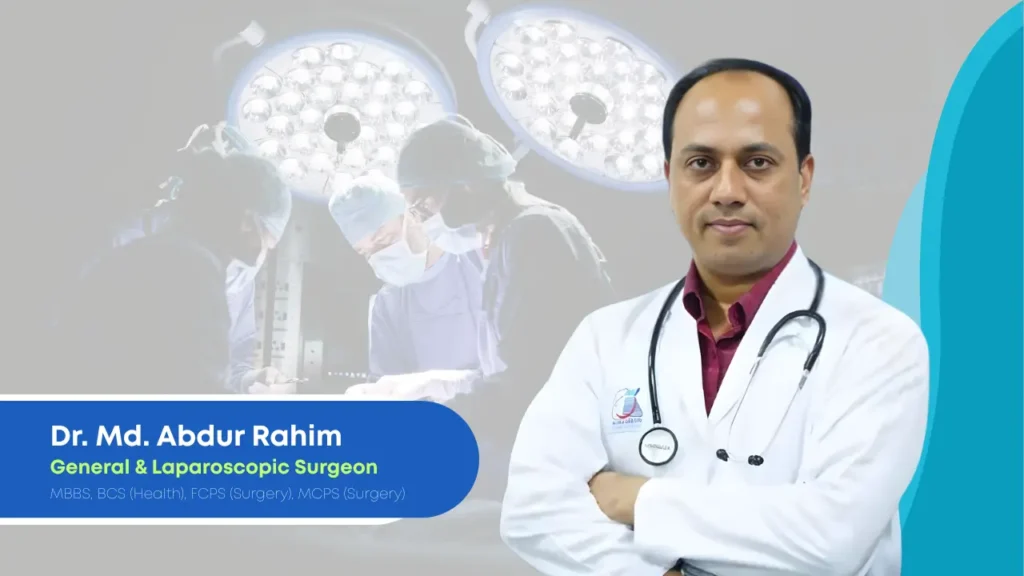
By Dr. Md. Abdur Rahim — General & Laparoscopic Surgery Specialist, Chittagong Medical College & Parkview Hospital
Laparoscopic surgery, also known as keyhole surgery, is a modern minimally invasive procedure that uses small incisions and a camera to perform precise surgical operations inside the abdomen.
Core Benefits:
Traditional Surgery vs. Laparoscopic Surgery
| Feature | Traditional Surgery | Laparoscopic Surgery |
|---|---|---|
| Incision Size | Large cut | 0.5–1 cm small cuts |
| Pain | Moderate to high | Minimal |
| Hospital Stay | Several days | 1–2 days |
| Recovery | Slower | Faster |
| Scarring | Visible | Almost invisible |
| Infection Risk | Higher | Lower |
Patients choose laparoscopic procedures because it offers a faster, safer, and more comfortable experience with excellent long-term results.
This section is structured for an infographic layout with bullet blocks.
A few tiny openings (0.5–1 cm) are made in the abdomen.
A high-definition camera provides a clear view of internal organs.
Fine instruments are inserted through the small openings.
The surgeon performs the operation safely under magnified vision.
Incisions are closed neatly, producing almost invisible scars.
Outcome: Most patients return home the same day or the next day depending on the condition.
Years of performing advanced laparoscopic surgeries with consistently successful outcomes.
Strong proficiency in keyhole surgery using modern instruments and safe methods.
Recognized for academic excellence, clinical leadership, and advanced surgical expertise.
Trusted specialist for gallbladder surgery, hernia repair, appendectomy, and abdominal surgeries.
Clear communication, detailed counseling, personalized surgical plans, and attentive aftercare.
High-quality equipment, clean surgical environment, and dedicated medical staff.
SEO Keywords Strengthened:
best laparoscopic surgeon Chittagong, CMCH surgeon, Parkview Hospital laparoscopic specialist, general surgeon Chittagong
These symptoms require timely evaluation to prevent complications.
Dr. Rahim provides tailored post-operative instructions for a smooth and comfortable recovery.
Expert Answers by Dr. Md. Abdur Rahim, General & Laparoscopic Surgery Specialist in Chittagong
Laparoscopic surgery is a minimally invasive procedure performed through small incisions using a camera and specialized instruments. Unlike traditional open surgery, which requires a large cut, laparoscopic surgery creates significantly less pain, faster recovery, minimal scarring, and lower risk of infection.
Patients in Chittagong commonly choose this modern technique for gallbladder removal, hernia repair, appendicitis, and various abdominal conditions due to its safety and efficiency.
Yes. When performed by a skilled and experienced surgeon like Dr. Md. Abdur Rahim, laparoscopic surgery is extremely safe. The magnified camera view allows better precision, reduces bleeding, and improves overall surgical outcomes.
Worldwide research consistently shows that laparoscopic procedures have fewer complications and better recovery results compared to open surgery.
Laparoscopic surgery treats a wide range of abdominal and gastrointestinal problems, including:
Dr. Rahim specializes in all major minimally invasive procedures, making him one of the leading laparoscopic surgeons in Chittagong.
Most patients recover significantly faster compared to open surgery.
Typical recovery timeline:
Recovery may vary depending on the type of surgery, the patient’s overall health, and the complexity of the case. Dr. Rahim provides individualized post-operative guidance to ensure a smooth recovery.
Pain is typically minimal and manageable. Because the incisions are small, most patients experience significantly less discomfort than they would after open surgery. Any pain that does occur can be easily controlled with prescribed medications.
Scarring is very minimal. Most incisions are only 0.5–1 cm, resulting in tiny marks that fade over time. For many patients, the scars become almost invisible after healing.
Most laparoscopic surgery patients stay 1–2 days. Some minor procedures may allow same-day discharge. Hospital stay depends on the patient’s condition and type of surgery, but overall stays are much shorter compared to open surgery.
Most patients are suitable candidates. However, your eligibility depends on:
A detailed evaluation with Dr. Rahim will determine whether laparoscopic surgery or another method is the safest and most effective option for you.
Laparoscopic surgery has a very low risk profile, especially in experienced hands. Still, all surgeries have some potential risks, such as:
Dr. Rahim prioritizes safety and thorough pre-operative assessment to minimize any risks.
The cost varies depending on the type of surgery (gallbladder, hernia, appendix, etc.), hospital facilities, tests, and the complexity of the case.
Laparoscopic surgery is often more cost-effective in the long run because it reduces hospital stays, recovery time, and complications.
For an exact estimate, patients can contact Parkview Hospital directly.
Yes. Most patients return to desk jobs within 7–14 days and resume normal activities within a few weeks. Strenuous physical work may require more time depending on the surgery type.
Patients choose Dr. Rahim because of:
He is widely trusted for gallbladder surgery, hernia repair, appendectomy, and complex abdominal cases in Chittagong.
Seek immediate medical attention if you experience:
Early diagnosis prevents complications and ensures safer treatment.
Failure rates are extremely low when performed by a qualified surgeon. Most procedures provide permanent results. Rarely, a recurrence (such as hernia) may require correction, but this is uncommon when the surgery is performed properly.
Preparation usually includes:
Proper preparation ensures a safe and smooth surgical experience.
Parkview Hospital Limited, Panchlaish, Chittagong
Laparoscopic surgery is the modern solution for patients seeking safer, faster, and less painful treatment for abdominal conditions. With advanced skills, extensive experience, and a strong track record, Dr. Md. Abdur Rahim is one of Chittagong’s leading experts in minimally invasive surgical care.
If you’re experiencing gallbladder, hernia, appendix, or abdominal issues, this could be the safest path to recovery. Schedule your consultation to receive expert, compassionate treatment.
Stay updated with the latest burn and plastic surgery tips, guides, trends and insights on burn care, reconstructive surgery, and preventive care.
When facing a surgical condition, choosing an experienced and qualified general surgeon in Chittagong is essential for safe treatment and…
Read More
When it comes to safe, advanced, and compassionate surgical care, choosing the best general surgeon in Chittagong is crucial. Among…
Read More
By Dr. Md. Abdur Rahim — General & Laparoscopic Surgery Specialist, Chittagong Medical College & Parkview Hospital What Is Laparoscopic…
Read More